
Key Takeaways
- MiniMax M3 — the first open-weight model to combine frontier coding, a 1M-token context window, and native multimodal input (text + image + video).
- MiniMax Sparse Attention (MSA) — a novel mechanism that reduces compute by 28.4x at 1M context by attending only to the 2,048 most relevant tokens per query, backed by a peer-reviewed arXiv paper.
- Priced at 5-10% of rivals — $0.30/M input tokens (promo) vs $5.00 for Opus 4.8 and GPT-5.5, making it the best dollar-for-dollar coding model available through an API today.
- Caveat emptor — benchmarks are self-reported, licensing restricts commercial self-hosting, and abstract reasoning remains a weakness.
1. The Model That Does Three Things at Once
On June 1, 2026, Shanghai-based AI lab MiniMax released M3 — the first open-weight model to deliver three frontier capabilities simultaneously: 59.0% on SWE-Bench Pro (edging GPT-5.5's 58.6%), a 1M-token context window, and native understanding of text, images, and video from the ground up.
The enabler of this trifecta is MiniMax Sparse Attention (MSA) — a novel architecture that makes 1M-token inference computationally practical. Without it, running full attention over a million tokens would be prohibitively expensive on any hardware available today.
2. The O(n²) Problem
Standard softmax attention scales quadratically with context length — doubling the context quadruples the compute. At 1M tokens, a single forward pass becomes impossible. The industry has explored sparse attention patterns, KV-cache compression, and linear attention variants, but each introduces tradeoffs.
MSA's approach is elegantly practical: instead of attending to all tokens, it identifies the few that actually matter for each query and computes attention over those alone. As other open-weight models like Switzerland's Apertus 70B face the same scaling laws, this breakthrough matters far beyond MiniMax.
3. How MSA Works
Two-Stage Block Selection
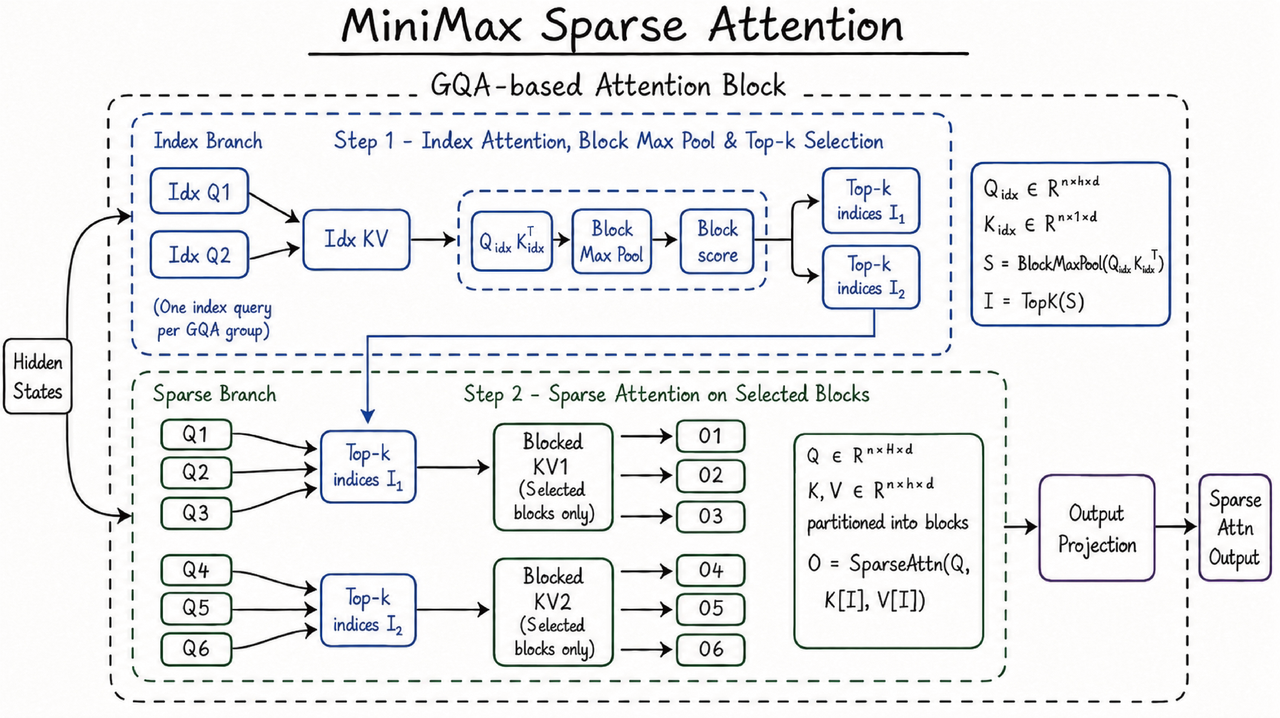
MSA operates in two stages. First, an Index Branch divides the KV cache into 128-token blocks and selects the top 16 most relevant per GQA group — group-specific sparsity that differentiates MSA from uniform approaches. Then the Main Branch runs exact attention over only those ~2,048 KV tokens, a fixed budget regardless of context length. The result is sub-quadratic scaling: compute stays constant as context grows.
GPU Co-Design
To translate sparsity into real speedups, MiniMax built a custom kernel with exp-free top-k selection, KV-outer sparse attention (batching queries that need the same block), and contiguous memory access — each block read once.
| Metric | Improvement (vs Full Attention @ 1M) |
|---|---|
| Attention compute per token | 28.4x reduction |
| Prefill wall-clock (H800) | 14.2x speedup |
| Decoding wall-clock (H800) | 7.6x speedup |
MSA vs DeepSeek MLA
MSA represents a genuine architectural fork from DeepSeek's Multi-head Latent Attention (MLA). While DeepSeek compresses KV data into a latent space (better memory efficiency, precision tradeoff), MSA operates on uncompressed KV data — preserving long-context retrieval accuracy at higher memory cost. The MSA paper (arXiv 2606.13392) provides 30 pages of peer-reviewed detail for the community.
4. Performance and Benchmarks
| Benchmark | M3 Score | Context |
|---|---|---|
| SWE-Bench Pro | 59.0% | Above GPT-5.5 (58.6%), below Opus 4.8 (69.2%) |
| Terminal-Bench 2.1 | 66.0% | Agentic CLI task completion |
| BrowseComp | 83.5% | Above Opus 4.7 (79.3%) |
| AA Intelligence Index | 55 | #1 open-weight, behind Opus 4.8 (61.4) |
MiniMax also published three impressive real-world demos: an autonomous ICLR 2025 paper reproduction (12 hours, 18 commits), a CUDA FP8 GEMM kernel achieving 9.4x speedup (24 hours, 147 submissions), and fully autonomous model training across 4 untrained base models in 12 hours.
5. Pricing — The Killer Advantage
| Model | Input ($/M tokens) | Output ($/M tokens) |
|---|---|---|
| M3 (promo) | $0.30 | $1.20 |
| M3 (standard) | $0.60 | $2.40 |
| Claude Opus 4.8 | $5.00 | $25.00 |
| GPT-5.5 | ~$5.00 | ~$30.00 |
A typical coding task (500K input, 100K output) costs $0.27 at promo pricing — roughly 5% of Opus 4.8. Even at standard rates ($0.54/task), M3 is an order of magnitude cheaper for high-volume workflows.
6. The Honest Caveats
Licensing: Open-Weight ≠ Open-Source
M3 uses the MiniMax Community License (CC BY-NC 4.0). Commercial use requires a separate agreement with MiniMax. Do not deploy in production without legal verification.
Self-Reported Benchmarks
All scores come from MiniMax's own infrastructure, and comparisons used Opus 4.7 (64.3%), not the current Opus 4.8 (69.2%). The gap to today's frontier is ~10 points wider than headlines suggest. Independent Chatbot Arena results are still pending.
Weak Abstract Reasoning
ARC-AGI-2 scores are "low single digits." Independent reviewer Thomas Wiegold reported M3 spent 30-40 minutes on a poker simulation with only mediocre results. This is a competent executor, not a general reasoning replacement.
Overthinking & Data Sovereignty
Cheap per-token pricing doesn't mean cheap per-task pricing if the model overthinks on complex problems. Additionally, MiniMax is Shanghai-based — Chinese data laws apply to all API traffic regardless of user location.
7. Bottom Line
MiniMax M3 is the strongest dollar-for-dollar coding model available through an API today. Its MSA architecture is a genuine breakthrough — the peer-reviewed arXiv paper provides real depth for the community to build on. For developers who need frontier coding, massive context windows, and multimodal input at a fraction of the price of proprietary alternatives, M3 is a compelling choice.
But it's not a magic bullet. Licensing restricts self-hosting, abstract reasoning lags frontier models, and the benchmarks need independent validation. What M3 represents is proof that sparse attention can deliver frontier capability at practical costs — a roadmap for the next generation of long-context models.
Want more on the open-weight landscape? Check out our deep dive on Apertus 70B and our complete guide to RAG.
Featured image: MiniMax Sparse Attention (MSA) architecture diagram. Source: MiniMax Official Blog.
External Sources:






0 Comments