
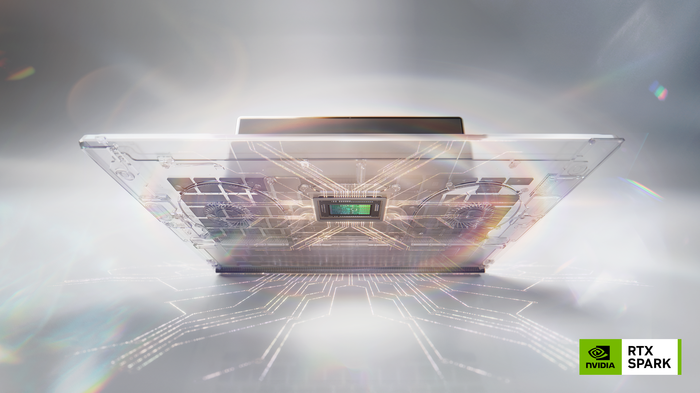
Image: NVIDIA Newsroom — official press image of the NVIDIA RTX Spark superchip
NVIDIA RTX Spark is a Grace-Blackwell superchip for Windows PCs that combines a 20-core Arm CPU with a Blackwell RTX GPU via NVLink-C2C interconnect, delivering up to 1 petaflop of AI compute and 128 GB of unified memory. Announced at Computex Taipei on May 31, 2026, it's the most ambitious attempt yet to bring personal AI agents to every desk — backed by Jensen Huang's $200 billion market thesis.
The Superchip That Changes the PC
For forty years, the PC has been a point-and-click tool. NVIDIA RTX Spark is designed to break that cycle completely.
Built on TSMC 3nm with roughly 70 billion transistors, the RTX Spark combines NVIDIA's first custom Arm CPU — a 20-core design co-developed with MediaTek (10 Cortex-X925 + 10 A725) — with a Blackwell RTX GPU packing 6,144 CUDA cores and 5th-gen Tensor Cores supporting FP4 precision. The two halves talk over NVLink-C2C at 600 GB/s and share up to 128 GB of unified LPDDR5X memory. That unified pool is the killer feature: AI models stay resident while the GPU runs inference, the CPU handles agent orchestration, and Windows manages your browser tabs — all without a single PCIe data transfer.
The first wave includes 30+ laptops and 10+ desktops from ASUS, Dell, HP, Lenovo, Microsoft Surface, and MSI, shipping Fall 2026. Morgan Stanley estimates the N1X at $2,899+ and the N1 at $1,799+, though these remain unconfirmed.
| Spec | N1X (Flagship) | N1 (Mainstream) |
|---|---|---|
| CPU | 20-core Grace Armv9 | 10–12 core Grace Armv9 |
| GPU | 6,144 CUDA cores, 5th-gen Tensor | 2,048–2,560 CUDA cores |
| AI Compute | 1 PFLOPS (FP4) | ~350 TFLOPS (FP4) |
| Memory | Up to 128 GB unified LPDDR5X | Up to 64 GB unified LPDDR5X |
| Power | ~80W sustained | ~45W (18W minimum) |
| Local LLMs | 120B params, up to 1M-token context | 70B params, ~512K-token context |
| Form Factor | 14mm thin, ~3 lbs laptops | Fanless designs possible |
"You Ask, and the PC Does the Work"
"We'll have billions of agents, and those billions of agents will all use tools," Jensen Huang said at Computex. "And those tools are going to be like PCs, just like us humans using PCs today." This is the north star for RTX Spark: the PC evolves from a productivity tool into an intelligent teammate that executes goals across applications, files, and cloud services autonomously.
Video: NVIDIA — RTX Spark official announcement video showcasing the superchip's vision for personal AI agents, creative workflows, and gaming.
That vision needs hardware that runs agents locally — with low latency, strong privacy, and enough memory to keep a 1M-token context window hot for hours. No existing laptop can do that. A MacBook Pro with 128 GB unified memory comes close on paper, but lacks NVIDIA's CUDA ecosystem and the agent-security stack Microsoft and NVIDIA are building together. As we covered in our guide to AI agents in production, the gap between prototype-quality agents and production-ready infrastructure remains the industry's biggest bottleneck.
NVIDIA OpenShell — Security for Autonomous Agents
Running an agent locally with access to your files, email, and terminal — unattended for hours — requires serious security. NVIDIA's answer, released under Apache 2.0, is OpenShell: an out-of-process runtime that decouples the agent from its own safety policy. The agent runs in a sandbox; the policy lives in the runtime. Even if the agent is compromised, it cannot override its constraints.
OpenShell enforces three layers: kernel-level sandboxing (filesystem, network, process isolation), a YAML policy engine (declarative rules at binary and path level), and a Privacy Router that keeps sensitive context on-device with local Nemotron models, routing only anonymized queries to cloud LLMs when permitted.
Early adopters include Hermes Agent (Nous Research) and OpenClaw, both building native agent applications for RTX Spark. As Nous Research CEO Dillon Rolnick put it: "You realize you're buying a full-fledged assistant, not a typical laptop." For readers interested in the broader agent safety landscape, our AI safety deep-dive examines how runtime-level isolation fits into the growing regulatory pressure around agent safety.
Adobe, Gaming, and 100+ Partners
The strongest signal of RTX Spark's seriousness comes from Adobe, which is rearchitecting Premiere Pro and Photoshop from the ground up for unified memory and TensorRT acceleration — unlocking real-time 12K editing and GPU-accelerated compositing. On the gaming side, RTX Spark delivers 100+ FPS at 1440p with ray tracing and DLSS 4.5, plus native anti-cheat support across 1,000+ RTX-accelerated titles. The ecosystem already spans 100+ partners including Blender, ComfyUI, llama.cpp, OTOY, Maxon, Topaz Photo, and MATLAB — making it the best-supported AI PC platform at launch.
Video: NVIDIA — Jacob Freeman demos RTX Spark laptops running agent workflows, creative apps, and gaming at Computex 2026.
The Honest Caveats
Transparency matters, and RTX Spark has real question marks that any informed buyer should weigh.
Pre-Production & Bandwidth Reality
Every performance figure is from NVIDIA's own benchmarks on pre-production silicon — no independent tester has verified a shipping RTX Spark device. More critically, the headline 600 GB/s NVLink-C2C speed is the chip-to-chip interconnect, while the actual LPDDR5X memory bandwidth is ~273–300 GB/s. That's what gates LLM inference speed, and it's roughly half the Apple M5 Max's ~600 GB/s and a fraction of an RTX 5090's ~1,792 GB/s. Token generation will be slower than high-end desktop GPUs, despite the impressive petaflop headline.
CPU & Windows-on-ARM Risk
Leaked Geekbench scores put the Grace CPU at ~3,125 — behind the M5 Max (~4,350) and Snapdragon X2 Elite (~4,050). NVIDIA used off-the-shelf Cortex cores rather than custom silicon, limiting single-threaded performance in a laptop likely costing over $2,500. Add to that Microsoft's troubled Arm history (the Surface RT was a $900 million write-off), and Prism emulation still trailing Rosetta 2 in developer perception. Real-world compatibility depends on developers building Arm-native apps — and the PC industry has been burned before.
For a broader perspective on how the open-source model ecosystem is reshaping hardware decisions, our deep-dive on the open-source AI revolution examines why platform lock-in matters more than ever for AI builders.
RTX Spark vs. the Competition
| Spec | RTX Spark N1X | Apple M5 Max | AMD Strix Halo |
|---|---|---|---|
| AI Compute | 1 PFLOPS (FP4) | ~18 TFLOPS (FP32) | ~45 TFLOPS |
| Max Memory | 128 GB unified | 128 GB unified | 128 GB unified |
| Mem Bandwidth | ~300 GB/s | ~600 GB/s | ~210 GB/s |
| CPU Perf | ~3,125 Geekbench | ~4,350 Geekbench | ~3,800 Geekbench |
| CUDA/AI Stack | Full CUDA + TensorRT | Metal / MLX | ROCm / DirectML |
| Agent Runtime | OpenShell + Windows | macOS agent tools | Windows x86 native |
| Availability | Fall 2026 | Now | Now |
Who Should Buy — and Who Should Wait
Buy if: You're building AI agents locally and need CUDA, 128 GB unified memory, and OpenShell's security runtime. Creative pros using Adobe, Blender, or DaVinci Resolve will see transformative gains. Wait if: CPU performance is your priority — Apple's M5 Max and AMD's Strix Halo offer better single-core speed today. Linux developers face a Windows-only launch, and Stratechery's Ben Thompson has argued that cloud-centric architectures may make more strategic sense — worth reading before committing several thousand dollars.
For context on how personal agents and cloud infrastructure are converging, see our guide to the AI agent economy.
The Bottom Line
NVIDIA RTX Spark is the most ambitious attempt to redefine what a PC can be since the iPhone redefined the phone. The hardware genuinely impresses — the first Windows laptop that can run a 120B-parameter model with a million tokens of context, all while keeping your data local and your agent sandboxed by OpenShell.
But ambition isn't delivery. The memory bandwidth caveat, the CPU performance gap, and the pre-production uncertainty demand cautious optimism rather than unqualified enthusiasm. RTX Spark's success hinges on whether the first wave of $2,500+ laptops actually delivers the experience Jensen Huang described: you ask, and the PC does the work. If it does, the PC industry changes. If it stumbles, Fall 2026 will still be the most consequential season for PC hardware in over a decade.
FAQ
Q: What is NVIDIA RTX Spark?
A: It's a Grace-Blackwell superchip for Windows PCs that integrates a 20-core Arm CPU and a Blackwell RTX GPU via NVLink-C2C, delivering up to 1 petaflop of AI compute with 128 GB unified memory for running agents locally.
Q: When is it available and how much will it cost?
A: First devices ship Fall 2026 from ASUS, Dell, HP, Lenovo, and Microsoft Surface. Morgan Stanley estimates $2,899+ for the N1X and $1,799+ for the N1, though OEM pricing is unconfirmed.
Q: Can it run existing Windows software and games?
A: Yes — Prism x86 emulation handles x86 apps, and native anti-cheat (BattlEye, Easy Anti-Cheat) plus growing Arm-native game support ensures broad compatibility.
Sources: NVIDIA Newsroom · TechCrunch · NVIDIA Developer Blog · Stratechery
Photo Credit: Featured image courtesy of NVIDIA Newsroom. Used under NVIDIA press licensing terms.
Video Credits: Embedded videos from the official NVIDIA YouTube channel.
GetYourDozAi is an independent publication covering AI technology and its impact on creators, developers, and businesses.





0 Comments