
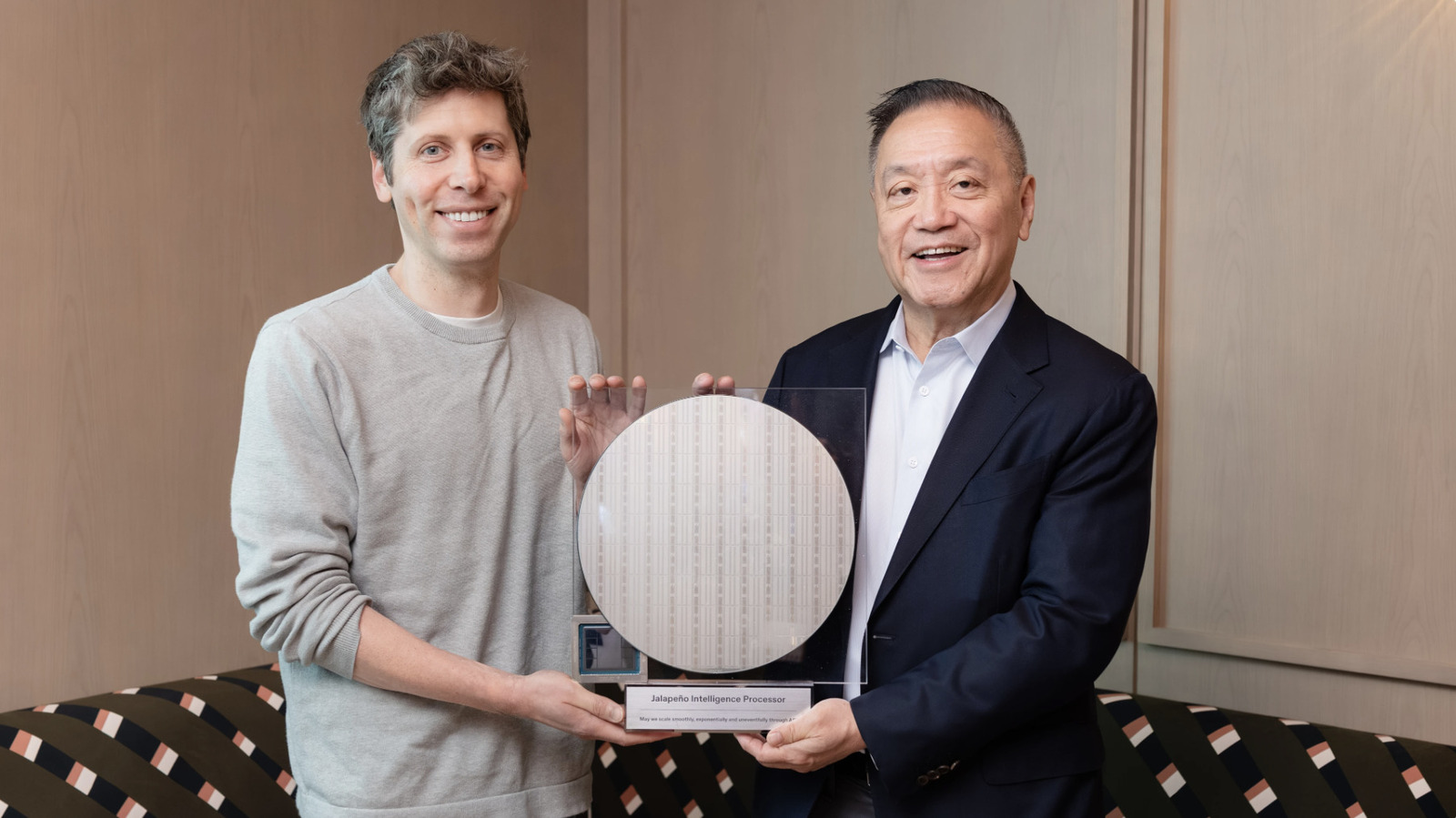
OpenAI and Broadcom just unveiled Jalapeño — a reticle-sized ASIC purpose-built for LLM inference that delivers an estimated ~50% reduction in inference cost per token compared to Nvidia GPUs. Engineering samples are already running GPT-5.3-Codex-Spark, and mass deployment begins by late 2026.
Also read: For the full technical breakdown with chip architecture details and competitive analysis, check out our companion article on TekMag: OpenAI Jalapeño — The Custom Inference Chip That Challenges Nvidia's Empire.
This isn't just another chip announcement. It's OpenAI's escape hatch from a $14B annual inference bill — and its boldest move yet toward full-stack AI dominance. Here's how Jalapeño works, why the 9-month timeline made waves, and what cheaper inference means for every developer building on OpenAI's platform.
What Is Jalapeño? A Chip Built for One Job
Most AI hardware today uses GPUs — general-purpose graphics processors that are flexible enough to train models AND run inference. That flexibility comes with overhead. Jalapeño is the opposite approach: an ASIC (Application-Specific Integrated Circuit) designed from the ground up for exactly one workload — running LLMs after they've been trained.
Think of it like the difference between a Swiss Army knife and a chef's knife. A GPU can do everything — graphics, training, inference. An ASIC does one thing brilliantly. Jalapeño's architecture is tuned for LLM inference kernels, memory movement patterns, transformer-layer networking, and serving scheduling — eliminating the overhead that makes Nvidia's H100s and B200s less efficient at pure inference.
Built on TSMC's 3nm process, the chip was co-developed by OpenAI (frontend architecture and design) and Broadcom (backend silicon implementation, IP, and supply chain), with system integration by Celestica. It's the first in a planned multi-generation compute platform — and Microsoft has already committed to buying 40% of first-phase output.
The $7B Math: Why OpenAI Needed Its Own Silicon
To understand why Jalapeño matters, you need to see OpenAI's 2025 financial reality:
| Metric | Amount |
|---|---|
| Revenue | $13.07B |
| Total Expenses | $34B |
| Operating Loss | -$20.92B |
| Payments to Microsoft for Compute | $10.59B |
| Estimated ChatGPT Inference Spend | ~$14B |
OpenAI spent roughly $14 billion on ChatGPT inference in 2025 alone — over a third of its total expenses and more than its entire revenue. Even a 20% reduction saves $2.8B/year. At the claimed 50%, that's ~$7B/year — roughly one-third of their operating loss eliminated by hardware alone.
With OpenAI reportedly preparing for a 2026 IPO, Jalapeño isn't optional engineering — it's the most important financial lever the company has.
The 9-Month Miracle (and Why Engineers Are Skeptical)
The headline figure that grabbed everyone's attention: Jalapeño went from design to tape-out in just 9 months — what Broadcom CEO Hock Tan called "the fastest ASIC development cycle ever achieved in high-performance advanced semiconductors."
That's genuinely impressive by any measure. But Hacker News chip engineers quickly raised important caveats. The 9-month clock likely started at RTL freeze (when the chip's logic design was finalized), not at the beginning of concept exploration. From concept to working silicon, the timeline is probably closer to 18-24 months — still fast, but not otherworldly.
What is remarkable is that first silicon works at all. Most bleeding-edge ASICs require multiple respins. Jalapeño's prototypes are already running GPT-5.3-Codex-Spark at production-level workloads — a sign that OpenAI and Broadcom got the architecture right on the first try.
Video: Jalapeño — What It Means for Nvidia and the AI Chip Landscape
AI Designing AI: The Recursive Flywheel
Here's where the story gets truly self-referential. OpenAI used its own models — the very same GPT family that runs on GPUs today — to design Jalapeño. The company's AI systems generated testbenches, wrote SystemVerilog boilerplate, optimized chip layouts, and accelerated verification cycles.
This creates a powerful feedback loop: AI helps design a chip that runs AI cheaper, which lets OpenAI afford to train better AI, which designs better chips. It's the recursive self-improvement flywheel that technologists have been talking about for years — now operating in real silicon.
The Custom Silicon Arms Race
OpenAI was the last major AI company without its own custom silicon. Now the playing field looks like this:
| Company | Custom Silicon | Status |
|---|---|---|
| TPU (v1–v7) | Most mature, massive scale | |
| Amazon | Trainium / Inferentia | $50B OpenAI deal for 2GW Trainium |
| Microsoft | Azure Maia 100 → 200 (3nm) | Powers GPT-5.2; second gen shipping |
| Meta | MTIA (300–500 series) | In production |
| OpenAI | Jalapeño (with Broadcom) | Announced June 24, 2026 |
This chart tells a simple story: every hyperscaler is trying to escape the Nvidia tax. Microsoft built Azure Maia to power its own AI workloads. Google has seven generations of TPUs. Amazon has Trainium and Inferentia. Now OpenAI joins the club — though it's trading Nvidia dependency for Broadcom dependency, which some analysts see as a lateral move.
Video: The Real Story — Claude Code Competition and AI-Designed Silicon
What This Means for Developers
If you build on the OpenAI API, Jalapeño's impact should reach you within 12-18 months in three ways:
- Cheaper API calls: A 50% reduction in OpenAI's inference cost doesn't guarantee 50% lower prices, but it creates massive room for price cuts — especially as competition from Anthropic, Google, and open-source models intensifies.
- Faster responses: An ASIC tuned specifically for transformer inference can deliver lower latency per token than a general-purpose GPU handling the same workload.
- Lower subscription costs: ChatGPT Plus and Pro tiers could see price reductions or feature expansions as the underlying infrastructure gets cheaper.
This is part of a broader trend we've covered before. As we saw with NVIDIA's RTX Spark superchip, the entire industry is racing to build hardware purpose-fit for AI workloads rather than repurposing gaming GPUs. The difference is that NVIDIA builds for everyone; OpenAI builds for itself — and that vertical integration is unprecedented at this scale.
The Skeptic's Corner
Before we declare Jalapeño a revolution, let's be honest about the caveats:
- No independent benchmarks. OpenAI says "a detailed technical report will be presented in the coming months." Every performance claim — including that 50% figure — is self-reported.
- Inference only. Jalapeño cannot train models. Pre-training still needs Nvidia (or AMD/Cerebras). The chip is hyper-specialized by design.
- Broadcom lock-in. OpenAI swapped Nvidia dependency for Broadcom dependency. Broadcom has a history of leveraging partnerships into eventual acquisitions.
- Architecture risk. A chip tightly tuned for today's transformer architectures could lose value if models shift toward state-space models, hybrid approaches, or something we haven't seen yet.
- Full production is 18+ months out. While prototypes work today, scaling to full production speed isn't expected until early 2028.
These don't diminish the achievement — but they add essential context, especially given what we've learned about OpenAI's recent reward model challenges. The company is moving fast, and with that speed comes risk.
Bottom Line
Jalapeño marks the moment OpenAI stopped being just an AI lab and became a full-stack infrastructure company. It now designs the chips, the kernels, the memory systems, the networking, the scheduling, the deployment systems, the models, and the products that run on them. No other AI company owns this much of the stack.
The 50% cost reduction won't hit your API bill tomorrow. But the direction is clear: AI inference is getting dramatically cheaper, and the companies that control their own silicon will lead the next phase of the industry.
For more context on where OpenAI's model development is heading, check out our coverage of GPT-5.5-Cyber and the Patch the Planet initiative.
Sources
- OpenAI and Broadcom Official Press Release — GlobeNewswire
- Ars Technica — Technical Analysis (with critical caveats)
- VentureBeat — Best Financial Context & Competitive Landscape
- Tom's Hardware — Hardware Architecture Deep Dive
Featured image: Sam Altman (OpenAI CEO) and Hock Tan (Broadcom CEO) holding the Jalapeño Intelligence Processor wafer. Photo via OpenAI/Broadcom press release (Engadget).
GetYourDozAi covers AI infrastructure, model reviews, and automation tools. Follow us for the latest in AI hardware and deployment strategies.





0 Comments